How does generative AI produce a response?
CS 450 · AI and the World · September 14, 2026
- You can say what happens between your question and the reply, and why a fluent, confident answer can still be wrong.
It can pass the bar exam and still miscount the letters in strawberry
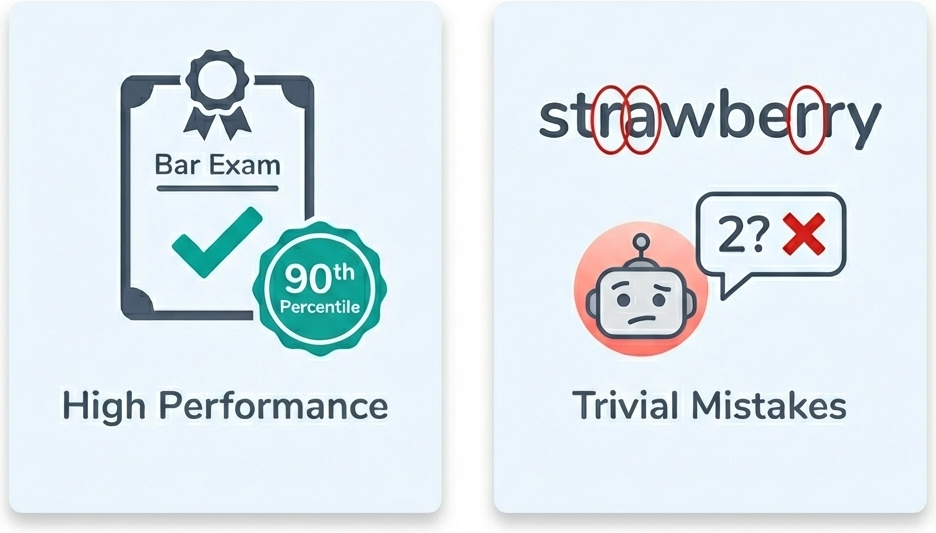
A bar exam result marked at the ninetieth percentile sits beside a chat reply that counts the letter r in strawberry as two.
- The same model scores in the top tenth on bar exam questions.
- You type a ten-letter word and ask it to count one letter.
- The reply appears left to right, a piece at a time, confident and complete.
- The count is wrong.
A classifier picks a label; a generator writes the next piece
Diagram explanation
A classifier turns measurements into a species label and stops, while a generator turns the text so far into a next piece that is added back to the text.
- Flower measurements leads to Model
- Model leads to Species
- Text so far leads to Model
- Model leads to Next piece
- Next piece leads to Text so far: added back
- Two weeks ago the model turned inputs into one prediction: a label.
- Generative AI
- A model whose prediction is new content, not a category.
- Language model
- A model trained to predict the next piece of text.
- Its output goes back in as input, so it keeps going.
The model never sees letters; it sees tokens
- Token
- A chunk of text from a fixed list, the unit the model works in.
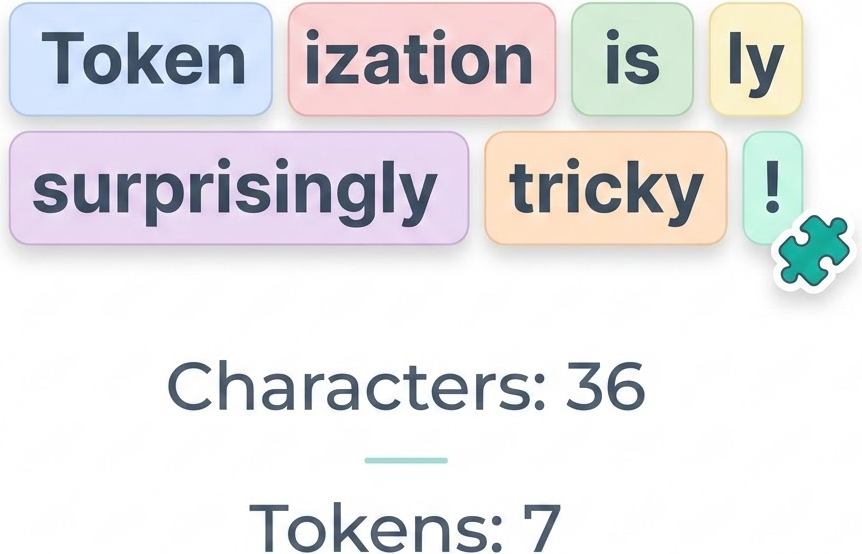
One short sentence shown as seven coloured chunks, with thirty-six characters counted against seven tokens.
- Common words are one token; rarer words split into pieces.
- The model receives the pieces. It never counts the letters inside one.
- Limits and prices are quoted in tokens for the same reason.
Generation is one prediction, repeated
- Next-token prediction
- Score every possible next piece, pick one, add it.
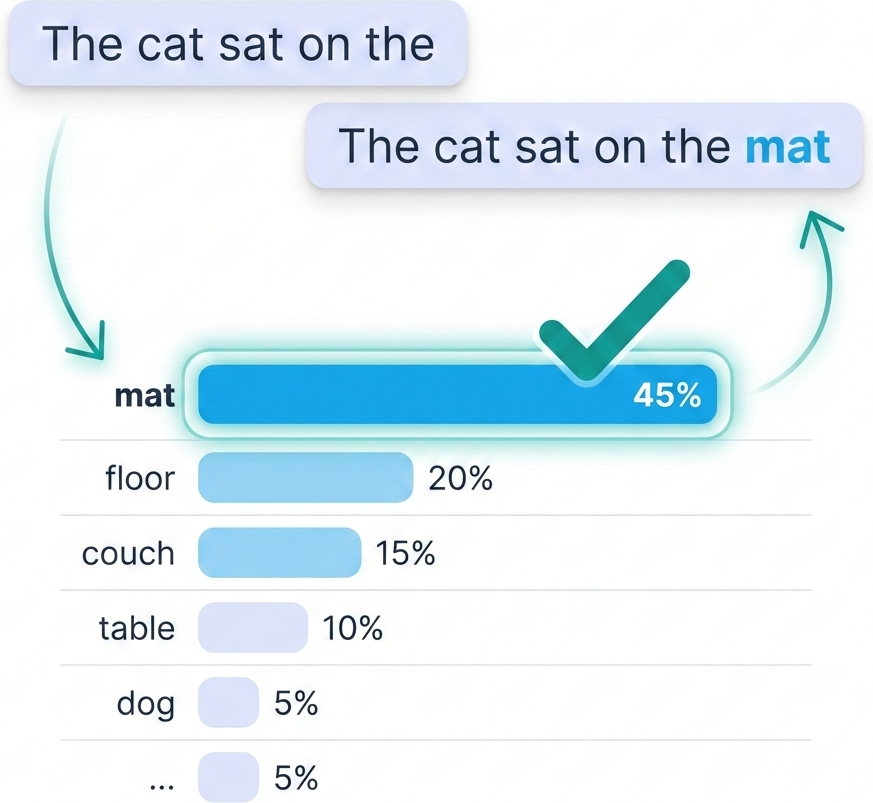
Candidate next pieces for an unfinished sentence are ranked by score, and the top-scoring one is added to the sentence.
- Then run again on the longer text.
- A whole reply is that step a few hundred times.
- Nothing plans the sentence; each piece only follows the ones before it.
A student asks a chat app what year Einstein published special relativity. It answers 1905, correctly. What happened?
- A. It found 1905 in a table of facts stored inside the model
- B. It predicted 1905 as the likely next piece
- C. It worked the year out from what it knows about Einstein
- D. It copied 1905 from a document it had read during training
This anonymous poll does not count toward your grade.
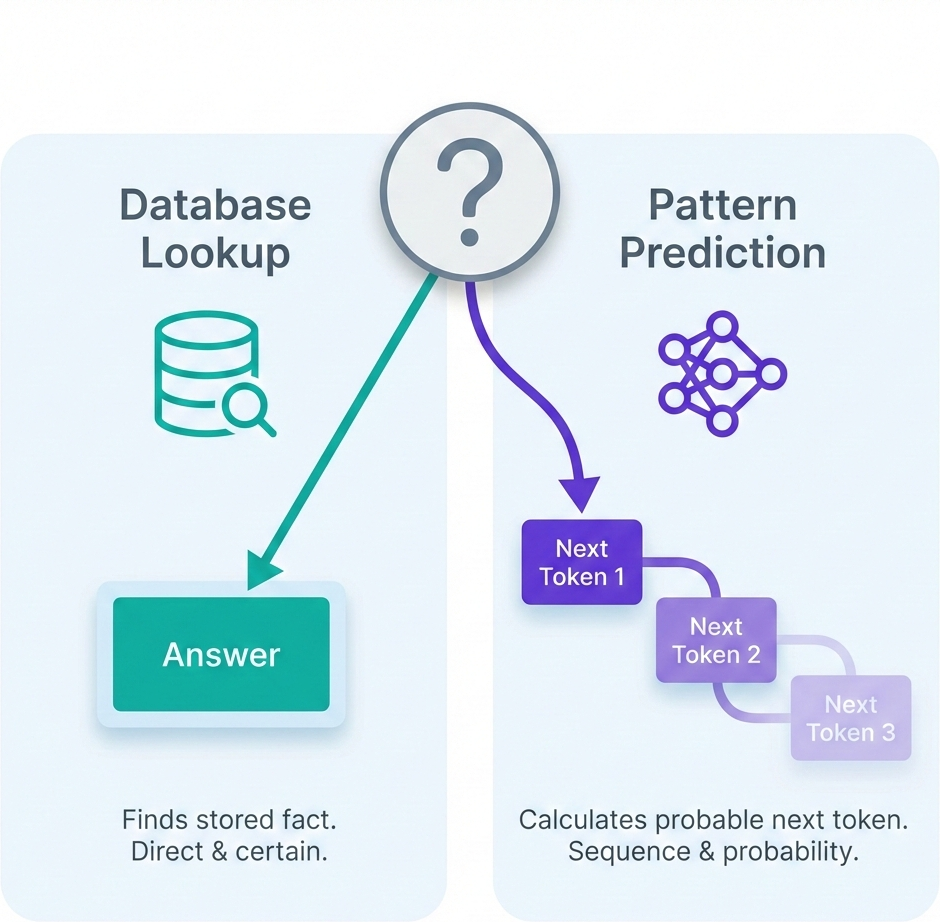
Two ways a question could be answered, one by finding a stored fact and one by calculating a probable next piece.
Nothing in the loop looks anything up
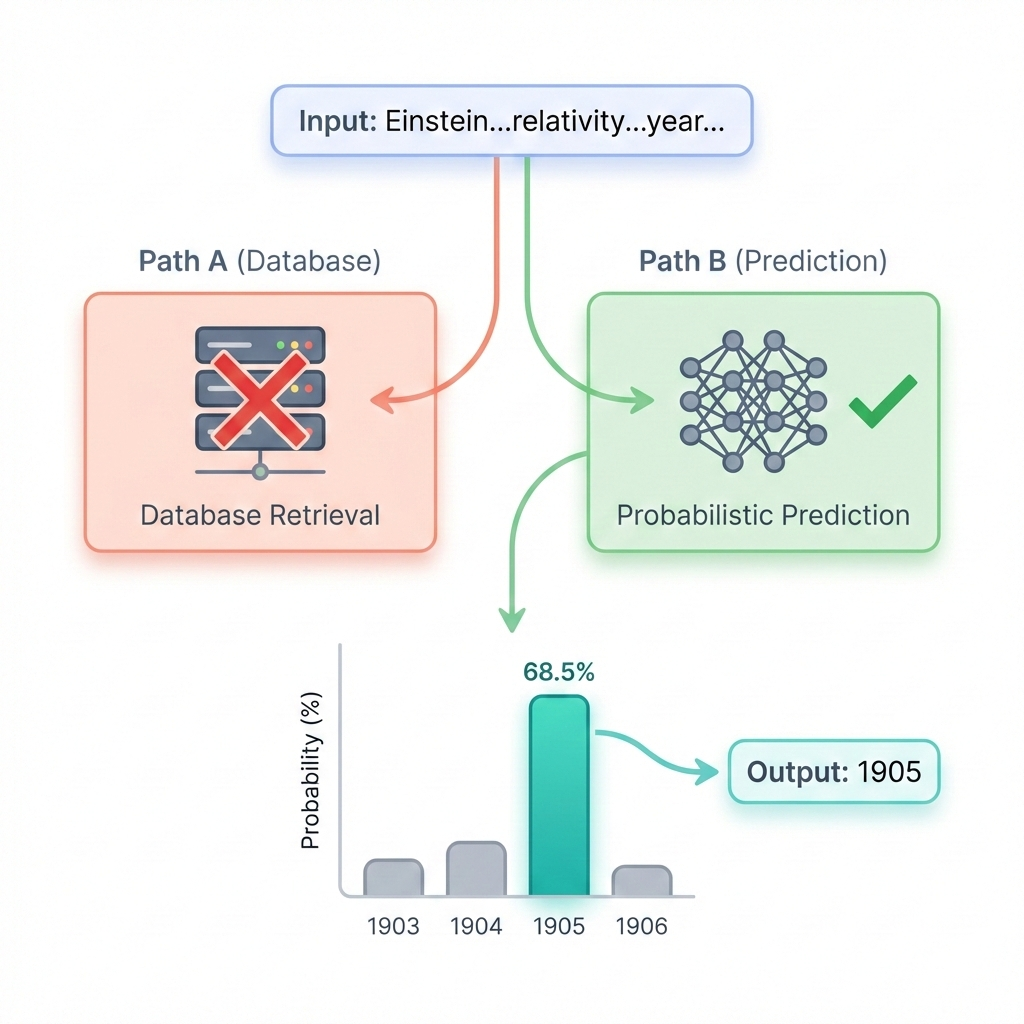
A question about Einstein is answered by scoring candidate years and returning the highest-scoring one, with the database route crossed out.
- A search engine finds a document that already exists.
- A language model produces text that statistically follows your prompt.
- Parameters
- Billions of numbers left behind by training, holding which pieces follow which.
- Right answers come out of the same loop: The capital of France is → Paris.
Training played the same next-piece game on the internet
- Pre-training
- Show the model text, ask it to predict what comes next, correct it.
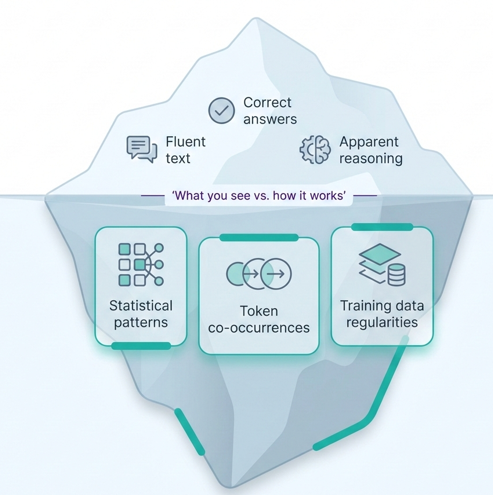
Fluent text, correct answers and apparent reasoning sit above the waterline; statistical patterns, token co-occurrences and training-data regularities sit below it.
- Repeat over billions of examples of human writing.
- Make: training adjusts the numbers. Use: your prompt runs the finished loop.
- Using the model does not change it.
The next piece is drawn, not chosen
- Sampling
- The next piece is drawn from the ranked scores, not always the top one.
- Temperature
- A setting that sharpens the draw toward the top or spreads it out.
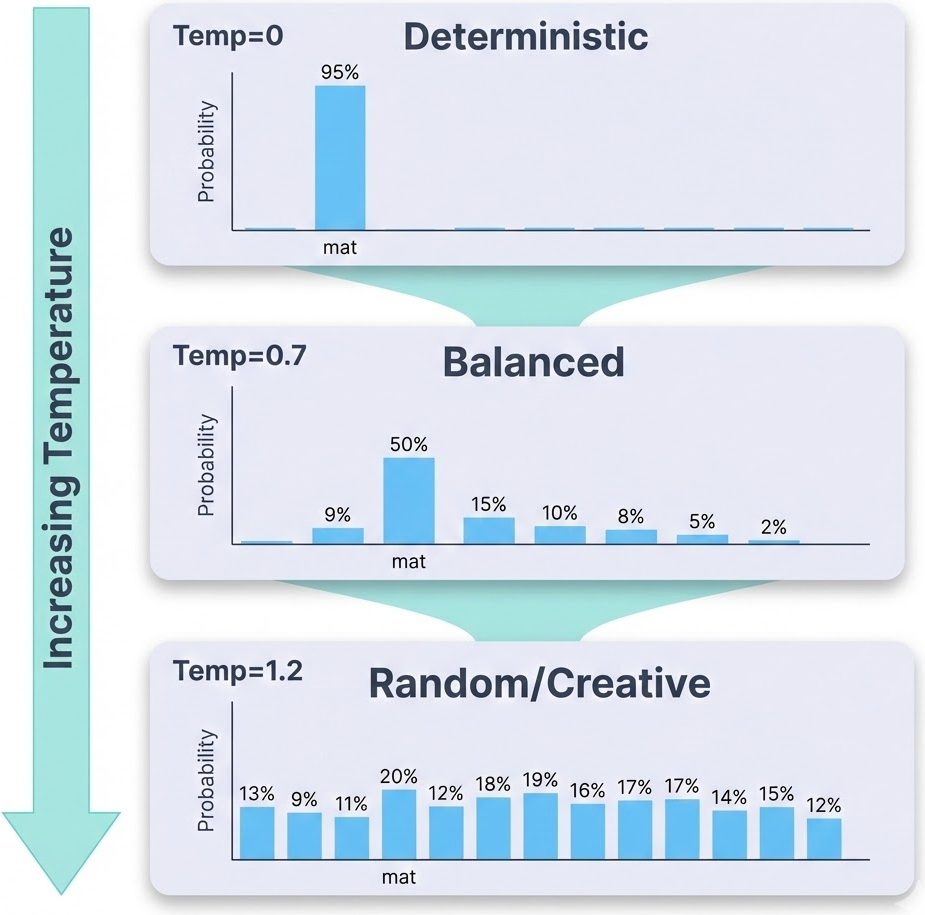
The same candidate scores are shown at three temperature settings, sharpening to one tall bar at the lowest and spreading almost flat at the highest.
- Low temperature: nearly the same reply each time. High: more variety.
- It changes how the model picks, not what it knows. It cannot fix the count.
The same question got three different replies
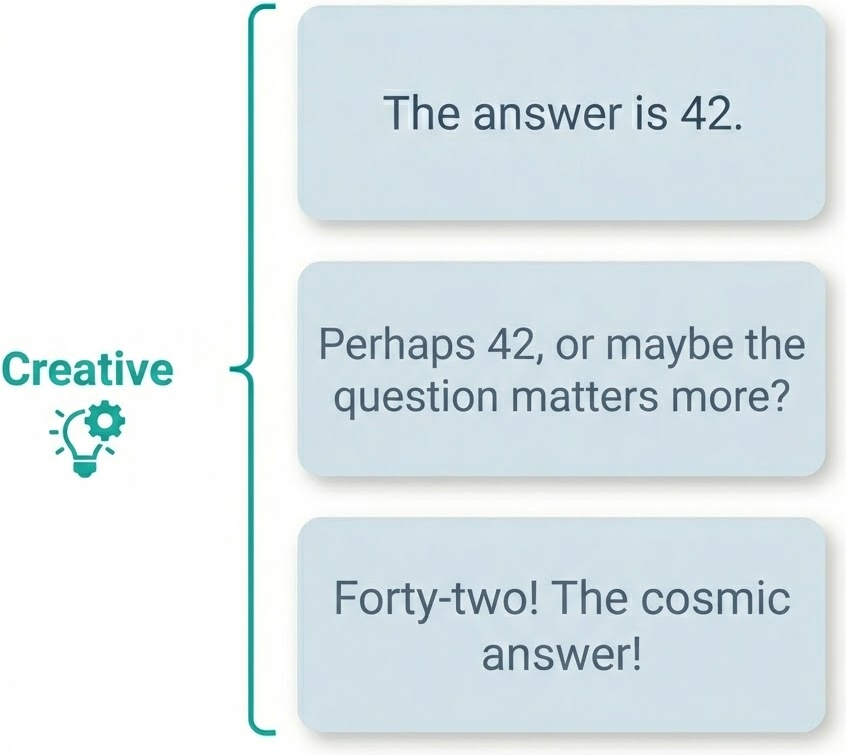
One question asked three times returns three replies that differ in wording and in how sure they sound.
- Same prompt, same model, three runs.
- Different wording, and the count can differ too.
- None of them is the answer; each is one draw.
- One screenshot cannot show what a model can or cannot do.
You want story ideas for a creative writing class, and separately you want the exact dates pulled out of a contract. Which temperature for which?
- A. High for both
- B. Low for both
- C. High for stories, low for dates
- D. Low for stories, high for dates
This anonymous poll does not count toward your grade.
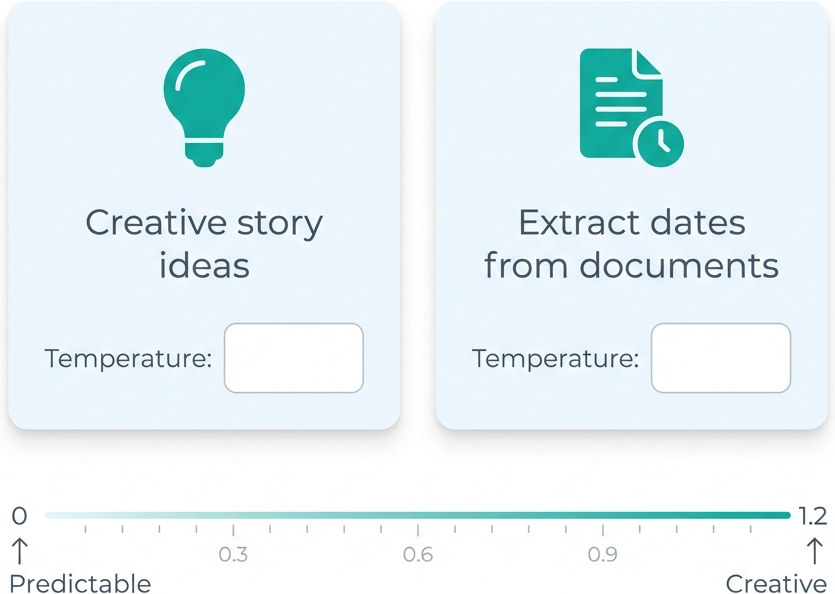
Two tasks, creative story ideas and extracting dates from documents, each with an empty temperature box above a scale from predictable to creative.
The scores measure plausible, not true
- Hallucination
- Fluent text that is false, produced by the same loop.
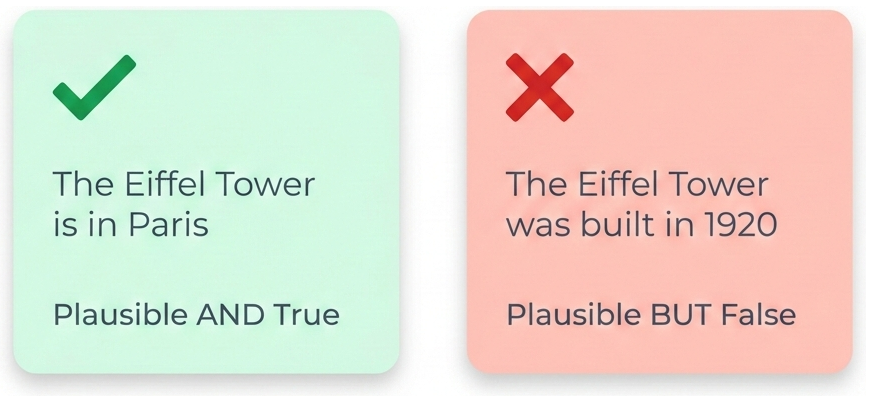
Two sentences about the Eiffel Tower read equally smoothly, and one of them is false.
- The scores rank what usually follows, not what is true.
- 2 scored well because that sentence shape is common.
- The letters that would have fixed it were never visible.
The least trustworthy parts are names, numbers, and citations
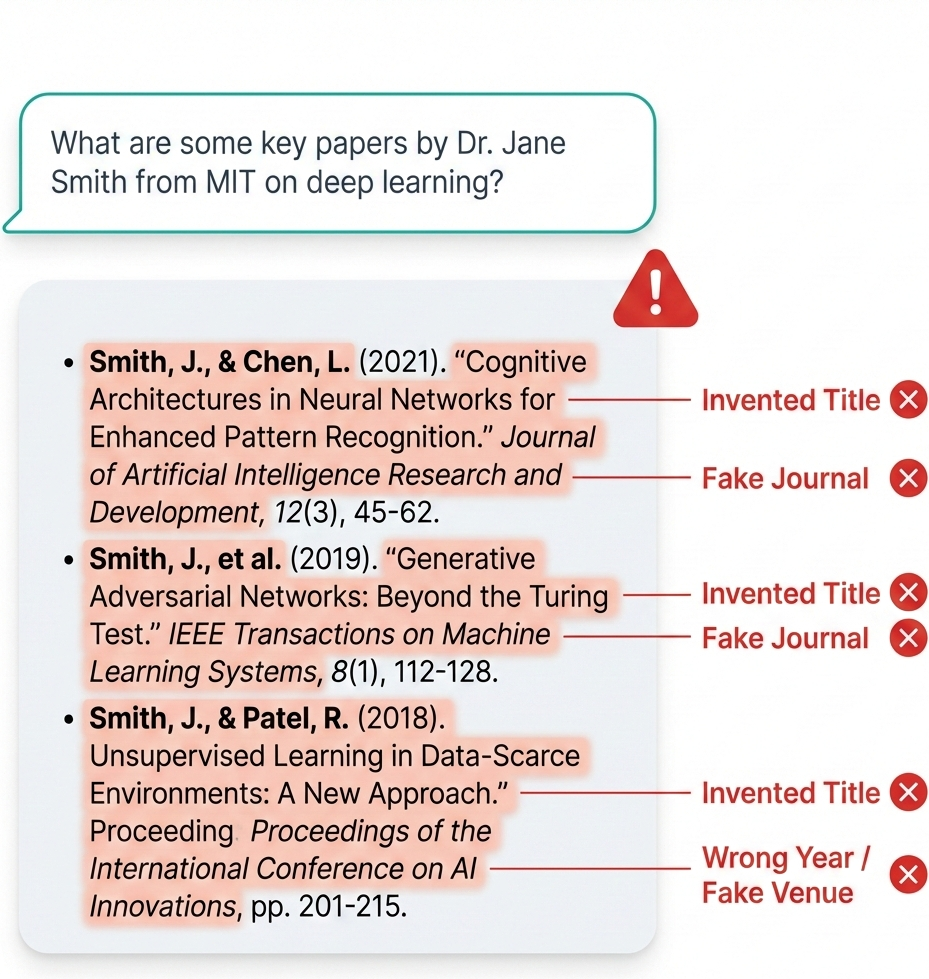
An example reply lists three academic references, and each invented title, journal and venue is flagged on the picture.
- Where a plausible sentence and a true one look alike, the loop cannot tell them apart.
- Names, numbers, dates, quotations and citations are exactly those places.
- The rest of the sentence around them can be perfectly good.
- Check those parts before you use them.
A language model writes the next piece; it does not look anything up
Candidate next pieces for an unfinished sentence are ranked by score, and the top-scoring one is added to the sentence.
- Pieces, not letters.
- One prediction, repeated.
- Drawn from scores, not looked up.
- So a confident answer is a plausible continuation, not a checked fact.